




scverse Foundational tools for single-cell omics data analysis
import scanpy as sc
sc.pl.umap(data, color='clusters')
Core packages
Logo for SnapATAC2
SnapATAC2

SnapATAC2 is a scalable and modular pipeline for analyzing single-cell ATAC-seq data, enabling efficient preprocessing, dimensionality reduction, clustering, and integration with single-cell RNA-seq.

Logo for AnnData
AnnData

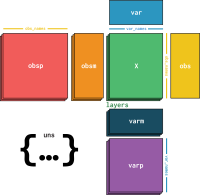
anndata is a Python package for handling annotated data matrices in memory and on disk, positioned between pandas and xarray. anndata offers a broad range of computationally efficient features including, among others, sparse data support, lazy operations, and GPU support.

Logo for decoupler
decoupler

decoupler is a framework containing different enrichment statistical methods to extract biologically driven scores from omics data within a unified framework.

Logo for MuData
MuData

MuData is a format for annotated multimodal datasets where each modality is represented by an AnnData object. MuData's reference implementation is in Python, and the cross-language functionality is achieved via HDF5-based .h5mu files with libraries in R and Julia.

Logo for Muon
Muon

muon is a Python framework for multimodal omics analysis. It provides functionality for working with multimodal data, including preprocessing, integration, and visualization.

Logo for Pertpy
Pertpy

Pertpy is a framework for analyzing large-scale single-cell perturbation experiments. It harmonizes datasets, automates metadata annotation, calculates perturbation distances, and analyzes cellular responses to genetic modifications, drugs, and environmental changes.

Logo for rapids-singlecell
rapids-singlecell

rapids-singlecell is a GPU-accelerated single-cell analysis library that serves as a drop-in replacement for scanpy, squidpy, and decoupler.

Logo for Scanpy
Scanpy

Scanpy is a scalable toolkit for analyzing single-cell gene expression data built jointly with anndata. It includes preprocessing, visualization, clustering, trajectory inference and differential expression testing. The Python-based implementation efficiently deals with datasets of more than one million cells.

Logo for Scirpy
Scirpy

Scirpy is a scalable toolkit to analyse T-cell receptor or B-cell receptor repertoires from single-cell RNA sequencing data. It seamlessly integrates with scanpy and provides various modules for data import, analysis and visualization.

Logo for scvi-tools
scvi-tools

scvi-tools is a library for developing and deploying machine learning models based on PyTorch and AnnData. With an emphasis on probabilistic models, scvi-tools streamlines the development process via training, data management, and user interface abstractions. scvi-tools also contains easy-to-use implementations of more than 14 state-of-the-art probabilistic models in the field.


Logo for SpatialData
SpatialData

SpatialData is a data framework that comprises a FAIR storage format and a collection of python libraries for performant access, alignment, and processing of uni- and multi-modal spatial omics datasets.

Logo for Squidpy
Squidpy

Squidpy is a tool for the analysis and visualization of spatial molecular data. It builds on top of scanpy and anndata, from which it inherits modularity and scalability. It provides analysis tools that leverages the spatial coordinates of the data, as well as tissue images if available.

View all scverse packages
Ecosystem

A broader ecosystem of packages builds on the scverse core packages. These tools implement models and analytical approaches to tackle challenges in spatial omics, regulatory genomics, trajectory inference, visualization, and more.

Continue to scverse ecosystem
Mission

scverse is a consortium of foundational tools (mostly in Python) for omics data in life sciences. It has been founded to ensure the long-term maintenance of these core tools.

Read more about scverse
Team

scverse is a community project currently governed by the developers of the core packages. Please reach out if you’d like to be involved!

Learn more about scverse community
References

scverse tools are used in numerous research and industry projects across the globe and are referenced in thousands of academic publications. Consider consulting the following references for more information about core scverse libraries and citing the relevant articles when using them in your work:

Virshup I, Bredikhin D, Heumos L, Palla G, Sturm G, Gayoso A, Kats I, Koutrouli M, scverse community, Berger B, Pe'er D, Regev A, Teichmann S, Finotello F, Wolf F, Yosef N, Stegle O, Theis F: The scverse project provides a computational ecosystem for single-cell omics data analysis. Nature Biotechnology. 2023 April 10
Wolf F, Angerer P, Theis FJ. SCANPY: large-scale single-cell gene expression data analysis. Genome Biology 19, 15 (2018)
Bredikhin D, Kats I, Stegle O. MUON: multimodal omics analysis framework. Genome Biology 23, 42 (2022)
Virshup I, Rybakov S, Theis FJ, Angerer P, Wolf FA. anndata: Annotated data. bioRxiv. 2021 Dec 19
Gayoso A, Lopez R, Xing G, Boyeau P, Valiollah Pour Amiri V, Hong J, Wu K, Jayasuriya M, Mehlman E, Langevin M, Liu Y. A Python library for probabilistic analysis of single-cell omics data. Nature Biotechnology. 2022 Feb 7:1-4
Sturm G, Szabo T, Fotakis G, Haider M, Rieder D, Trajanoski Z, Finotello F. Scirpy: a Scanpy extension for analyzing single-cell T-cell receptor-sequencing data. Bioinformatics. 2020 Sep 15;36(18):4817-8
Palla G, Spitzer H, Klein M, Fischer D, Schaar AC, Kuemmerle LB, Rybakov S, Ibarra IL, Holmberg O, Virshup I, Lotfollahi M, Richter S, Theis FJ. Squidpy: a scalable framework for spatial omics analysis. Nature Methods 19, 171–178 (2022)
Marconato L, Palla G, Yamauchi KA, Virshup I, Heidari E, Treis T, Vierdag WM, Toth M, Stockhaus S, Shrestha RB, Rombaut B. SpatialData: an open and universal data framework for spatial omics. Nature Methods. 2024 Mar 20:1-5